Nearly 88% of marketers plan to increase their influencer budgets in 2026, according to the Influencer Marketing Hub 2026 Benchmark Report — yet creator discovery and vetting remains the most frequently outsourced function in the industry. The reason is simple: picking the wrong creator doesn’t just waste budget. It damages brand credibility, derails campaign timelines, and produces content that sits in a folder no one opens.
This guide is part of our Brand Sponsorships & Creator Partnerships: The Definitive Playbook — your comprehensive resource for structuring, negotiating, and scaling creator partnerships that drive measurable results.
Vetting creators before you sponsor them isn’t a “nice to have” — it’s the single highest-leverage step in any influencer marketing program. The brands that nail this step consistently report higher engagement rates, stronger content quality, and better return on ad spend. The brands that skip it consistently burn through budgets wondering why “influencer marketing doesn’t work.”
In this guide, you’ll learn:
- Why surface-level metrics like follower count are unreliable indicators of creator quality
- The 7 critical dimensions every brand should evaluate before signing a creator deal
- How to detect fake followers, inflated engagement, and other red flags
- A repeatable vetting framework you can apply to any creator tier — nano to macro
- How AI-powered tools are automating the most time-intensive parts of creator evaluation
Table of Contents
- Why Creator Vetting Matters More Than Ever
- Beyond Follower Count: The Metrics That Actually Matter
- The 7 Critical Dimensions of Creator Vetting
- Red Flags: How to Spot Fake Followers and Inflated Metrics
- Building a Repeatable Creator Vetting Framework
- How AI Is Changing Creator Vetting
- Conclusion: Make Vetting Your Competitive Advantage
- FAQ
Why Creator Vetting Matters More Than Ever
The creator economy is maturing fast. With $44 billion in US creator ad spend forecast for 2026 (per the IAB, via Influencer Marketing Hub), brands are investing more per partnership — and the cost of a bad pick is rising proportionally.
The Real Cost of Skipping Due Diligence
A poorly vetted creator partnership doesn’t just underperform — it creates cascading problems. Misaligned brand values lead to audience backlash. Inflated engagement metrics make campaign reporting unreliable. Content that misses the brief forces expensive reshoots or kills the campaign entirely.
The brands running long-term creator partnerships know this firsthand: one bad creator can poison a six-month program. One strong creator can become your brand’s most authentic voice.
Why Traditional Vetting Falls Short
Most teams still vet creators by scrolling through Instagram grids, checking follower counts, and making gut-feel decisions. This approach worked when the creator pool was small and sponsorship deals were inexpensive. At today’s scale — with millions of creators across TikTok, Instagram, YouTube, and emerging platforms — manual vetting is both unreliable and unsustainable.
Beyond Follower Count: The Metrics That Actually Matter
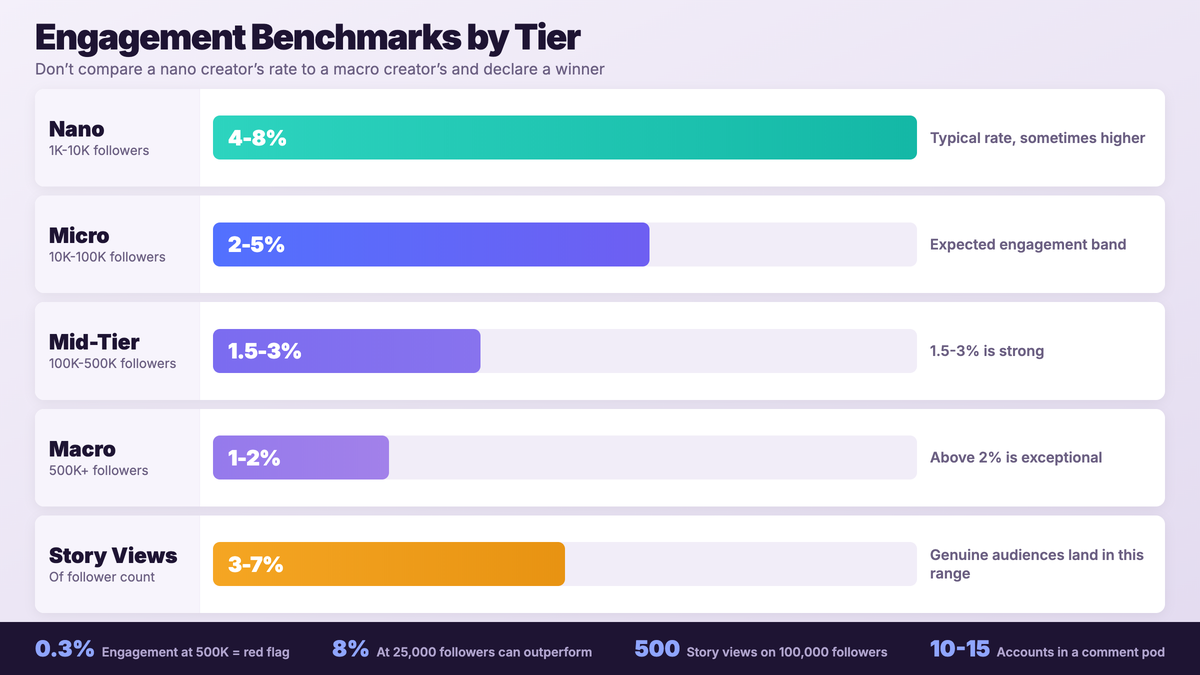
Follower count is the most visible metric — and the least reliable. A creator with 500,000 followers and 0.3% engagement is almost always a worse investment than a creator with 25,000 followers and 8% engagement. Here’s what experienced brand teams prioritize instead.
Engagement Rate by Tier
Engagement rate measures how actively a creator’s audience interacts with their content. But the benchmark varies dramatically by creator tier:
- Nano creators (1K–10K): Typical engagement rates of 4–8%, sometimes higher
- Micro creators (10K–100K): Expect 2–5% engagement
- Mid-tier (100K–500K): 1.5–3% is strong
- Macro (500K+): 1–2% engagement is standard; anything above 2% is exceptional
Don’t compare a nano creator’s 7% rate to a macro creator’s 1.2% and declare the nano “better.” Context matters. What you’re looking for is whether a creator outperforms their tier benchmark.
Audience Quality Over Audience Size
A creator’s audience demographics matter more than their total reach. Key questions to answer during vetting:
- What percentage of their audience is in your target geography?
- Does their audience age distribution match your customer profile?
- What’s the audience gender split, and does it align with your product?
- Are their followers concentrated in your target interest categories?
Platforms like partnrUP provide Audience Insight Reports that surface demographic data on each creator’s followers — so you can verify audience fit before spending a dollar.
Content Quality and Consistency
Review a creator’s last 20–30 posts, not just their highlight reel. Look for:
- Production quality: Is the lighting, framing, and editing professional enough for your brand standards?
- Caption quality: Do they write thoughtful captions, or just drop hashtags?
- Posting frequency: A creator who posts once a month may not deliver timely sponsored content
- Content evolution: Are they growing and refining their style, or recycling the same format?
The 7 Critical Dimensions of Creator Vetting
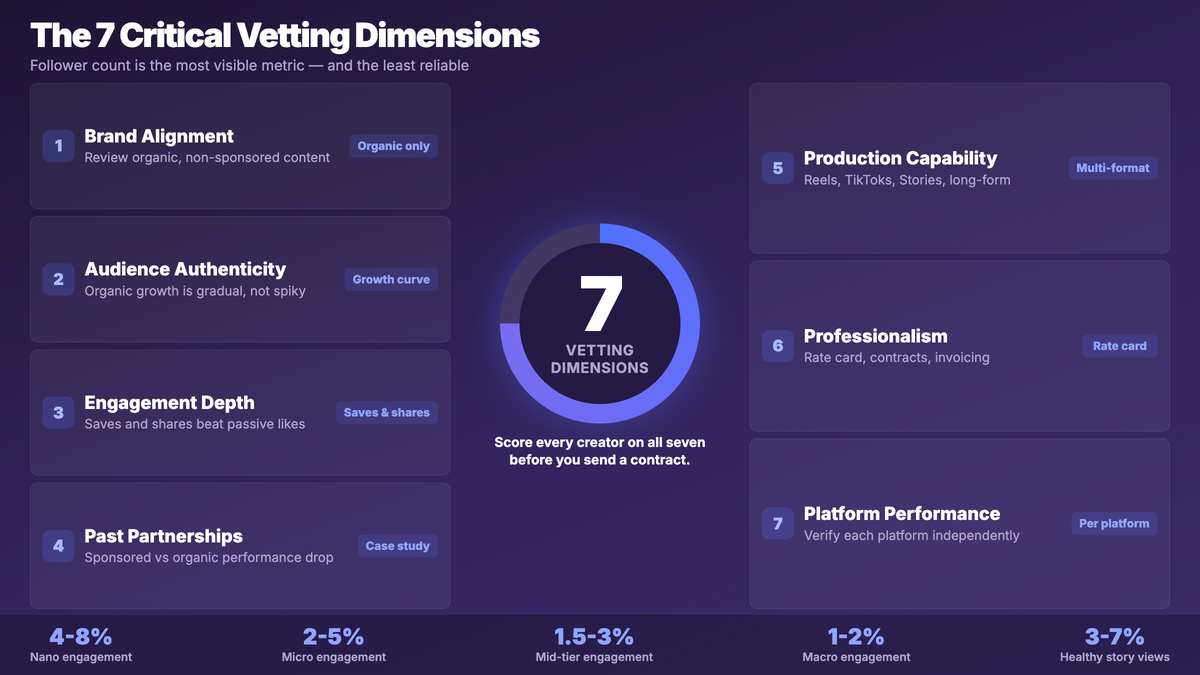
The most effective vetting frameworks evaluate creators across multiple dimensions simultaneously. Here are the seven that matter most for brand sponsorship decisions.
1. Brand Alignment
Does the creator’s personal brand, values, and aesthetic align with yours? Review their organic (non-sponsored) content to understand who they really are — not who they pretend to be in pitch decks. Check for past controversial statements, competitor partnerships, or content categories that conflict with your brand positioning.
2. Audience Authenticity
Verify that the creator’s followers are real people, not bots or purchased accounts. Look at follower growth patterns — organic growth is gradual; purchased followers show sudden spikes. Examine comment quality: are comments thoughtful and relevant, or generic (“Nice!” “Love this!” “🔥🔥🔥”) with suspicious account profiles?
3. Engagement Depth
Go beyond the like count. Saves, shares, and comments indicate deeper engagement than passive likes. A creator whose audience saves their content for reference or shares it with friends is producing genuinely valuable content — the kind that drives purchase consideration.
4. Previous Brand Partnership Performance
Ask for case studies or performance data from past sponsorships. How did their sponsored content perform versus their organic content? A significant drop in engagement on sponsored posts suggests their audience doesn’t trust their recommendations — a major red flag for brand partnership ROI.
5. Content Production Capability
Can this creator actually deliver what you need? Assess their ability to produce different content formats (Reels, TikToks, Stories, long-form YouTube), handle multi-platform deliverables, and meet deadlines. A creator who excels at Instagram carousels may struggle with TikTok’s faster, more casual style.
6. Professionalism and Communication
How quickly do they respond to outreach? Do they have a rate card or media kit? Can they sign contracts and provide invoicing details without extensive hand-holding? Professional creators treat sponsorships as a business, and that professionalism directly impacts your campaign execution timeline.
7. Platform-Specific Performance
A creator who dominates Instagram may have minimal presence on TikTok. If your campaign strategy requires multi-platform reach, verify performance on each platform independently. Check that their TikTok content converts differently than their Instagram content — and that both align with your campaign objectives.
Red Flags: How to Spot Fake Followers and Inflated Metrics
Influencer fraud remains a persistent challenge. Here’s how to identify creators who aren’t what they claim to be.
Follower Growth Anomalies
Plot a creator’s follower count over time (many analytics tools provide this). Organic growth looks like a gradual upward slope with occasional bumps from viral content. Purchased followers show sudden vertical spikes — 10,000+ followers gained overnight — followed by periods of stagnation or decline as platforms purge fake accounts.
Engagement-to-Follower Ratio Mismatches
If a creator has 200,000 followers but averages 150 likes per post, something is wrong. Calculate the engagement rate across their last 30 posts. If it’s dramatically below the tier benchmarks listed above, their audience likely includes a significant percentage of inactive or fake accounts.
Comment Quality Analysis
Scroll through the comments on recent posts. Red flags include:
- Generic one-word comments from accounts with no profile photos
- Comments in languages that don’t match the creator’s content language
- Identical or near-identical comments appearing across multiple posts
- Comment pods — the same group of 10–15 accounts commenting on every post
Story Views vs. Feed Engagement
Instagram Stories provide an additional data point. Creators with genuine audiences typically see Story views equal to 3–7% of their follower count. If a creator has 100,000 followers but only 500 Story views, their real audience is much smaller than their follower count suggests.
Building a Repeatable Creator Vetting Framework
Ad-hoc vetting doesn’t scale. Whether you’re evaluating 5 creators or 500, you need a structured process that produces consistent, comparable results.
Step 1: Define Your Non-Negotiables
Before reviewing any creator, document your hard requirements:
- Minimum engagement rate by tier
- Required audience demographics (geography, age, gender)
- Content format requirements (video-first, photo, UGC, etc.)
- Category exclusions (competitors, conflicting brands, sensitive topics)
- Budget range per creator tier
These non-negotiables become your first-pass filter. Any creator who doesn’t meet them gets eliminated immediately — no exceptions, no “let’s make it work.”
Step 2: Build a Standardized Scorecard
Create a scoring template that evaluates every creator across the 7 critical dimensions. Assign weights based on what matters most for your specific campaign goals. A brand awareness campaign might weight audience reach and brand alignment highest, while a creator commerce campaign would weight conversion history and content production capability.
Step 3: Implement a Tiered Review Process
Not every creator needs the same depth of review:
- Tier 1 (auto-filter): Use platform data and engagement benchmarks to eliminate obviously poor fits — this should be automated
- Tier 2 (quick review): Human review of top candidates’ content, audience quality, and brand alignment (10–15 minutes per creator)
- Tier 3 (deep dive): Full audit including past sponsorship performance, reference checks, and contract terms for your final selections
Step 4: Document and Iterate
After every campaign, go back to your vetting scorecard and update it. Which dimensions predicted success? Which creators scored high on your scorecard but underperformed? Use this data to calibrate your scoring weights for the next campaign. The brands with the best creator rosters treat vetting as a continuously improving system, not a one-time checklist.
How AI Is Changing Creator Vetting
Manual vetting is accurate but slow. According to the IMH 2026 Benchmark Report, AI is most commonly used for creator discovery, with only 10.56% of marketers reporting no AI usage at all. Here’s how AI-powered platforms are transforming the vetting process.
Automated Audience Analysis
AI tools can analyze a creator’s audience composition in seconds — flagging fake followers, identifying audience demographic breakdowns, and surfacing engagement authenticity scores. What takes a human 30 minutes per creator takes AI under a minute.
Predictive Performance Matching
AI-powered matching goes beyond historical metrics to predict which creators will perform best for your specific brand. By analyzing patterns across thousands of past campaigns, machine learning models identify the creator attributes — content style, audience psychographics, posting cadence — that correlate with strong outcomes in your category.
partnrUP’s discovery engine uses a proprietary algorithm combined with AI agents to evaluate creator fit across multiple dimensions simultaneously — matching on audience quality, content relevance, and brand alignment rather than just follower count. The platform’s AI Sourcing Agent identifies creators directly from social media and partnrUP’s growing network, while the Recruitment Agent evaluates and compares candidates on fit, reach, and engagement before sending personalized invitations.
Continuous Monitoring and Risk Detection
AI doesn’t just help at the selection stage — it monitors creator performance throughout the partnership. Sudden drops in engagement, follower anomalies, or content that drifts from brand guidelines can be flagged automatically, giving brands early warning signals before problems escalate.
Scaling Vetting Across Hundreds of Creators
For brands running programs with 50+ creators, manual vetting is a bottleneck. AI handles the heavy lifting — screening thousands of potential creators against your criteria and surfacing a shortlist of qualified candidates. Your team’s time goes to relationship building and creative strategy, not spreadsheet analysis. According to partnrUP’s platform data, this approach delivers 40% higher creator response rates through automated, personalized outreach and 70% less time spent on internal coordination.
Conclusion: Make Vetting Your Competitive Advantage
Creator vetting isn’t just a risk-mitigation step — it’s a competitive advantage. Brands that invest in rigorous, data-driven vetting consistently outperform those that rely on gut feel and follower counts. The framework is straightforward: define your non-negotiables, evaluate across all seven dimensions, automate what you can, and iterate based on results.
The tools exist to make this scalable. AI-powered platforms can handle audience analysis, authenticity scoring, and predictive matching in a fraction of the time manual processes require. The question isn’t whether you can afford to vet creators thoroughly — it’s whether you can afford not to.
Ready to see how AI-powered creator vetting works in practice? Book a demo and see how partnrUP’s matching engine evaluates creators across dozens of data points to find the right fit for your brand.
Frequently Asked Questions
How long should the creator vetting process take?
For a manual process, expect 15–30 minutes per creator for a thorough evaluation. AI-powered platforms can reduce this to under 5 minutes per creator by automating audience analysis, authenticity checks, and performance prediction. The key is building a repeatable framework so each evaluation follows the same criteria.
What’s the most important metric when vetting creators?
Engagement rate relative to tier benchmarks is the single most predictive metric for sponsorship success. A creator who consistently outperforms their tier’s average engagement rate is producing content that resonates with their audience — which translates to stronger brand partnership results.
How can I tell if a creator has fake followers?
Look for sudden spikes in follower growth (10,000+ gained overnight), engagement rates dramatically below tier benchmarks, generic or bot-like comments, and a mismatch between follower count and Story views. Many influencer marketing platforms include built-in authenticity scoring that flags these patterns automatically.
Should I vet nano creators differently than macro creators?
Yes. Nano creators (1K–10K followers) require less emphasis on audience demographics (their reach is limited) and more focus on content quality, engagement depth, and brand alignment. Macro creators (500K+) require rigorous audience demographic analysis, past sponsorship performance data, and contractual professionalism — the investment is higher, so the due diligence must match.
How do I evaluate a creator’s past sponsorship performance?
Request case studies or screenshots showing sponsored post metrics versus organic post metrics. Look for creators whose sponsored content maintains at least 70–80% of their organic engagement rate. A steep drop on sponsored posts suggests the audience doesn’t trust their recommendations. Also ask for references from previous brand partners — professional creators are happy to share them.
What role does AI play in creator vetting?
AI automates the most time-intensive vetting tasks: audience authenticity analysis, demographic breakdown, engagement pattern detection, and predictive performance matching. According to the IMH 2026 Benchmark Report, creator discovery is the most common application of AI in influencer marketing. Platforms like partnrUP combine AI-powered matching with human oversight to deliver vetted creator shortlists in minutes rather than days.
How often should I update my creator vetting criteria?
Review and refine your vetting scorecard after every campaign. Analyze which scoring dimensions predicted actual performance and which didn’t. Update engagement rate benchmarks quarterly as platform algorithms shift, and add new criteria as your campaign strategy evolves. The best vetting frameworks are living systems that improve with every data point, not static checklists filed away after the first use.