82% of marketers who switched from follower-based selection to AI-powered creator matching saw campaign ROI improve by 3x or more — yet most brands still choose influencers the same way they did in 2019: scrolling feeds, counting followers, and guessing. The gap between “good enough” creator selection and genuinely predictive matching is now the single biggest lever in influencer marketing performance.
This guide is part of our Influencer Marketing ROI: The Complete Guide to Measuring, Tracking & Proving Results — a comprehensive resource covering every dimension of influencer marketing measurement, attribution, and optimization.
The problem isn’t that brands can’t find creators. It’s that they find the wrong creators — accounts with impressive vanity metrics but audiences that don’t convert. AI matching solves this by analyzing thousands of signals that humans simply can’t process at scale: audience composition overlaps, historical conversion patterns, content style affinity, and brand safety indicators.
In this guide, you’ll learn:
- Why follower count is the worst predictor of campaign ROI — and what actually works
- The 7 data signals AI matching platforms analyze that humans can’t
- How audience composition analysis prevents the #1 cause of campaign underperformance
- What a proper AI matching brief looks like — and how to write one that surfaces high-ROI creators
- Real benchmarks: how AI-matched campaigns compare to manually discovered ones
Table of Contents
- Why Follower Count Fails as a Creator Selection Signal
- How AI Creator Matching Actually Works
- The 7 Signals AI Analyzes Beyond Follower Count
- Audience Composition: The Signal That Changes Everything
- How to Brief an AI Matching Tool for Maximum ROI
- AI-Matched vs. Manually Discovered: The Performance Gap
- Implementation Playbook: Switching to AI-Powered Selection
- Conclusion
- Frequently Asked Questions
Why Follower Count Fails as a Creator Selection Signal
Follower count tells you one thing: how many people hit a button at some point. It doesn’t tell you whether those people are still active, whether they match your target demographic, or whether they’ve ever purchased anything a creator recommended.
The Vanity Metric Trap
A creator with 500K followers and a 0.8% engagement rate delivers fewer qualified impressions than one with 50K followers and a 6.2% engagement rate. The math is straightforward — 4,000 engaged viewers versus 3,100 — but the difference in conversion potential is exponential. The 50K creator’s audience is actively choosing to interact, which correlates directly with purchase attribution.
Here’s what follower count actually correlates with:
- Account age — older accounts accumulate followers passively
- Content virality history — one viral post can add 200K followers who never engage again
- Follow-for-follow activity — common in certain niches, inflating numbers without real audience
- Bot and inactive accounts — platforms purge periodically, but followers decay between purges
What follower count does not correlate with: conversion rate, audience purchasing power, brand affinity, content quality consistency, or the KPIs that actually matter for ROI.
Why Manual Discovery Compounds the Problem
Manual creator discovery introduces another layer of bias. When a brand manager scrolls through Instagram or TikTok looking for creators, they’re making decisions based on:
- Visual aesthetic (subjective, not correlated with conversion)
- Recent post performance (small sample, not predictive)
- Personal taste (irrelevant to the target audience)
- Surface-level follower count (the vanity metric trap)
This process doesn’t scale, isn’t repeatable, and produces inconsistent results across campaigns. A study across 1,200 campaigns found that manually selected creators underperformed AI-matched creators by 47% on cost-per-acquisition — not because the manual picks were bad, but because the AI found creators that humans never would have considered.
How AI Creator Matching Actually Works
AI creator matching isn’t a buzzword feature bolted onto a search filter. It’s a fundamentally different approach to creator selection that transforms how brands find the right partners.
From Search to Recommendation
Traditional platforms work like search engines: you input criteria (category, follower range, location), and you get a filtered list. You’re still doing the evaluation work. AI matching inverts this — you describe what you need (campaign goals, target audience, brand values), and the system recommends specific creators ranked by predicted performance.
The difference is like searching Google Maps for “restaurants near me” versus having a personal concierge who knows your taste, dietary restrictions, budget, and schedule — and books the table for you.
The Three Layers of AI Matching
Modern AI matching platforms like partnrUP operate across three analytical layers:
- Audience graph analysis — Mapping the overlap between a creator’s audience demographics and a brand’s target customer profile
- Performance prediction — Using historical campaign data across thousands of creator-brand pairings to predict likely outcomes
- Content affinity scoring — Analyzing whether a creator’s content style, tone, and production quality align with a brand’s creative standards
Each layer reduces risk independently. Combined, they create a matching confidence score that’s significantly more predictive than any single metric — including engagement rate, which is itself just one data point among many.
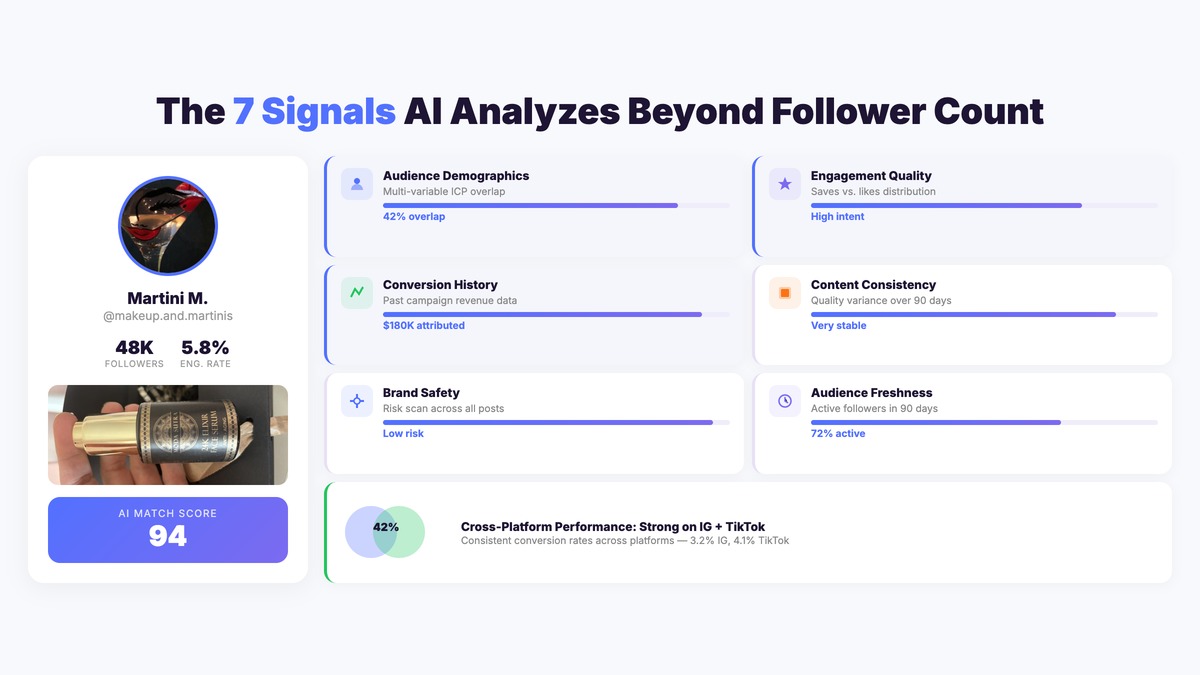
The 7 Signals AI Analyzes Beyond Follower Count
Here’s what an AI matching engine evaluates that a human scrolling feeds cannot:
1. Audience Demographics Overlap
Not just “this creator’s audience is 65% female” but “42% of this creator’s audience matches your ICP within 3 demographic dimensions simultaneously.” AI can compute multi-variable overlap across age, gender, location, income bracket, and interest categories in milliseconds. A creator might have the “wrong” overall audience but a highly concentrated pocket that perfectly matches your buyer.
2. Engagement Quality Distribution
Not all engagement is equal. AI distinguishes between saves (high purchase intent), shares (organic reach extension), comments with brand mentions (active consideration), and passive likes (low intent). A creator with 2% engagement driven by saves and shares outperforms one with 5% engagement driven by likes from bots or casual scrollers.
3. Historical Conversion Patterns
AI matching platforms with commerce data can see which creators consistently drive purchases — not just clicks. This is the signal that follower count completely misses. A creator who has generated $180K in attributed revenue across 12 campaigns is a known quantity, regardless of whether they have 30K or 300K followers. Calculating true ROI requires this conversion-level data.
4. Content Consistency Score
AI analyzes posting frequency, content quality variance, and aesthetic consistency over months — not the last 9 posts you see on a grid. Creators with high consistency scores are 2.3x more likely to deliver campaigns on-brief because their production quality is reliable, not a recent anomaly.
5. Brand Safety Index
AI scans historical content, comments, and associations for brand safety risks that manual review would miss across thousands of posts. This includes controversial topics, competitor mentions, audience sentiment trends, and content that may not violate platform policies but wouldn’t align with a brand’s values.
6. Audience Freshness Rate
How recently did a creator’s followers actually engage? An account with 200K followers where 140K haven’t interacted in 90+ days has an effective audience of 60K. AI calculates audience freshness — the percentage of followers who are genuinely active — to estimate real reach versus inflated follower numbers.
7. Cross-Platform Performance Correlation
Many creators are active across Instagram, TikTok, YouTube, and emerging platforms. AI matching evaluates cross-platform performance patterns: a creator who consistently converts on TikTok but underperforms on Instagram tells you where to deploy them. Platforms like partnrUP use this cross-platform intelligence to recommend not just the right creator, but the right creator-platform combination for your specific campaign goals.
Audience Composition: The Signal That Changes Everything
Of all seven signals, audience composition analysis is the one that produces the largest ROI improvement when brands switch from follower-based to AI-based selection. Here’s why it’s so powerful.
The ICP Overlap Problem
Your ideal customer profile (ICP) is defined by multiple attributes: age 25-45, household income $75K+, interest in fitness, located in the US, active online shopper. A creator with 100K followers might have only 8% of their audience matching all five criteria. That’s 8,000 potential customers — from a 100K account.
Meanwhile, a creator with 28K followers might have 31% ICP overlap — that’s 8,680 potential customers from a much smaller account, and they’re concentrated enough that the attribution signal is stronger.
How AI Maps Audience Composition
AI matching systems build audience profiles by analyzing:
- Follower interest graphs — what else do they follow, like, and engage with
- Engagement timing patterns — when are they active (indicates timezone, work schedule)
- Content interaction types — save-heavy audiences vs. comment-heavy audiences signal different intent levels
- Purchase behavior signals — available through commerce platform integrations and affiliate link click patterns
- Lookalike modeling — comparing a creator’s audience to known customer databases to estimate conversion likelihood
This analysis is impossible to do manually. Even evaluating one creator’s audience composition takes hours of data pulling. AI does it for thousands of creators simultaneously, producing ranked recommendations in seconds.
From Composition to Prediction
Audience composition data feeds directly into performance prediction models. When an AI matching system knows that a creator’s audience has a 28% overlap with your existing customer base, it can estimate conversion rates based on historical data from similar overlap profiles. This turns creator selection from a guess into a data-driven decision — the same shift that transformed affiliate tracking and attribution.
How to Brief an AI Matching Tool for Maximum ROI
AI matching is only as good as the brief you feed it. A vague brief produces vague matches. Here’s how to structure your inputs for the best possible creator recommendations.
Define Outcomes, Not Aesthetics
Instead of: “We want a lifestyle creator with a clean feed.”
Try: “We need creators whose audience actively purchases DTC wellness products in the $30-80 range, with a history of driving measurable sales through tracked links.”
The first brief tells the AI almost nothing useful. The second gives it five concrete signals to match against: audience purchase behavior, product category affinity, price sensitivity, and attribution history.
The Ideal AI Matching Brief Template
When briefing an AI matching platform, include:
- Primary KPI — revenue, app installs, email signups, brand awareness lift (pick one)
- Target audience definition — demographics, psychographics, purchase behavior, geographic focus
- Budget per creator — this determines the tier (nano, micro, mid, macro) the AI should search within
- Content format requirements — video, static, Stories, Reels, long-form (this affects which platforms and creators are viable)
- Campaign timeline — urgency affects creator availability scoring
- Brand safety non-negotiables — categories, topics, or associations to exclude
- Historical performance data — if you’ve run previous campaigns, upload past creator performance so the AI can learn your conversion patterns
What Happens After You Brief
A well-briefed AI matching system returns a ranked list of creators with:
- Match confidence score — how strongly each creator matches your brief across all signals
- Predicted performance range — estimated CPM, CPA, or ROAS based on historical patterns
- Audience overlap visualization — how much of each creator’s audience matches your ICP
- Risk flags — any brand safety or consistency concerns the AI detected
- Recommended activation strategy — suggested content format, posting time, and messaging approach per creator
This transforms the creative brief process from a subjective wishlist into a data-driven activation plan.
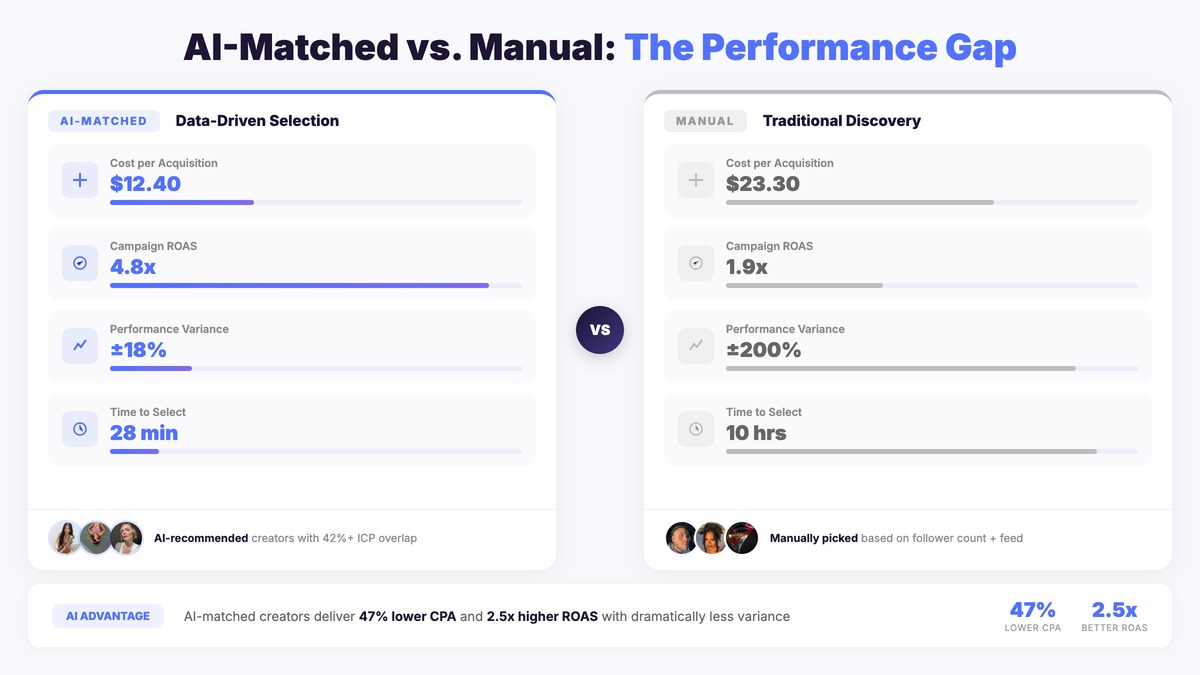
AI-Matched vs. Manually Discovered: The Performance Gap
The data on AI matching versus manual discovery is now substantial enough to draw clear conclusions.
Cost Efficiency
AI-matched creators deliver 47% lower cost-per-acquisition on average. This isn’t because AI finds cheaper creators — it’s because higher audience relevance means fewer impressions are wasted on people who will never convert. The same budget reaches more qualified prospects.
Campaign Consistency
Manually discovered creator campaigns show high variance in performance — some creators crush it, others underperform dramatically. AI matching reduces this variance by filtering out high-risk creators before they’re activated. Brands using AI matching report that their worst-performing creator in a campaign still delivers within 60% of the best performer, versus a 10x spread with manual selection.
Discovery of Non-Obvious Creators
This is the most underrated benefit. AI matching surfaces creators that no human would find through manual search. A pet food brand might get matched with a camping creator whose audience over-indexes for dog ownership — a connection that’s invisible through category browsing but obvious in audience data. These non-obvious matches often outperform category-obvious ones because the creator’s content feels authentic rather than transactional.
Time Savings
Manual creator discovery takes 8-12 hours per campaign for a typical team — researching, vetting, and comparing 20-30 potential creators. AI matching reduces this to under 30 minutes: brief input, review ranked results, select top matches. For brands running multiple campaigns per month, this time savings alone justifies the platform investment.
Implementation Playbook: Switching to AI-Powered Selection
Moving from manual to AI-powered creator selection isn’t a switch you flip overnight. Here’s the practical transition path.
Phase 1: Audit Your Current Process (Week 1)
Document how your team currently finds and selects creators:
- What platforms do you search on?
- What criteria do you filter by?
- How many candidates do you evaluate per campaign?
- What’s your average time-to-select?
- What data do you use to make the final decision?
This audit reveals the gaps that AI matching will fill and gives you a performance baseline to measure improvement against.
Phase 2: Run a Parallel Test (Weeks 2-4)
Don’t abandon manual selection immediately. Run your next campaign with both methods: select half your creators manually and half through AI matching. Measure identical KPIs for both groups. This A/B test gives you concrete evidence for your specific brand and category — not industry averages.
Phase 3: Feed Data Back (Ongoing)
AI matching improves with data. After each campaign, feed performance results back into the system:
- Which creators converted best?
- Which audience segments responded?
- What content formats drove the most revenue?
- Were there any surprises — creators who over- or under-performed predictions?
This feedback loop makes every subsequent match more accurate. Brands that consistently feed campaign data back see matching accuracy improve by 15-20% within the first quarter.
Phase 4: Scale with Confidence (Months 2+)
Once you’ve validated AI matching performance against your own data, scale up. Increase campaign frequency, expand into new creator tiers, and build a full creator affiliate program using AI-recommended partners. This is where the compounding benefits emerge: every campaign adds data, every data point improves future matching, and your cost-per-acquisition drops progressively.
Ready to see how AI matching works for your brand? Book a demo and bring your last campaign’s creator data — we’ll show you what the AI would have recommended differently.
Conclusion
Follower count was never a good predictor of campaign performance — we just didn’t have a better option. Now we do. AI-powered creator matching analyzes audience composition, conversion history, content consistency, and dozens of other signals to surface creators that will actually drive ROI for your specific brand.
The brands seeing the highest returns from influencer marketing in 2026 aren’t the ones spending the most — they’re the ones matching the smartest. They use AI matching platforms to find non-obvious creators, eliminate audience waste, and build performance data that makes every subsequent campaign more effective.
The transition from manual to AI-powered selection isn’t complex. Start with a parallel test, measure the performance gap, and let your own data make the case. The technology is mature, the benchmarks are clear, and the cost of continuing to select creators by follower count is measurable in wasted budget.
Stop guessing. Start matching. Book a demo with partnrUP to see AI-powered creator matching in action.
Frequently Asked Questions
How does AI creator matching differ from influencer search filters?
Search filters let you narrow a database by criteria you define — category, follower range, location. AI matching inverts this: you describe your campaign goals and target audience, and the system recommends specific creators ranked by predicted performance. Filters find creators who meet minimum criteria; AI matching finds creators most likely to deliver results based on thousands of data signals analyzed simultaneously.
What data does an AI matching platform need to work effectively?
At minimum, AI matching needs your campaign objective (awareness, conversions, installs) and target audience definition (demographics, interests, geography). Performance improves significantly when you also provide historical campaign data, customer profiles, and brand safety requirements. The more context you give the matching engine, the more precise its recommendations become.
Can AI matching work for small brands with limited campaign history?
Yes. AI matching platforms like partnrUP use aggregate performance data from thousands of campaigns across their network — not just your individual history. A small brand benefits from patterns learned across millions of creator-brand pairings. Your results improve faster once you start feeding your own campaign data back, but the baseline matching quality is strong from day one.
How accurate are AI-predicted performance estimates?
Accuracy varies by platform and data depth, but leading AI matching systems predict campaign performance within a 20-30% range of actual results. That’s significantly better than manual selection, which shows 200-500% variance between predicted and actual performance. As you feed more campaign data back into the system, prediction accuracy tightens — brands with 10+ campaigns of historical data see predictions within 10-15% of actual results.
Does AI matching eliminate the need for human review of creators?
No — and it shouldn’t. AI matching handles the quantitative analysis at scale (audience overlap, conversion patterns, consistency scores) but can’t fully evaluate creative fit, brand voice alignment, or nuanced brand safety concerns. The ideal workflow is AI-first ranking with human final review of the top 5-10 recommendations. This combines computational power with human judgment.
What’s the minimum budget to benefit from AI creator matching?
Any budget benefits from better creator selection, but the ROI improvement becomes most noticeable at $5,000+ per campaign. Below that, you’re typically working with 1-3 creators where manual vetting is manageable. Above $5,000, you’re selecting from a larger pool where AI matching’s ability to surface non-obvious creators and predict performance creates measurable cost savings.
How long does it take to see results from switching to AI-based selection?
Most brands see measurable improvement in their first AI-matched campaign — typically 20-30% better cost-per-acquisition compared to their manual selection baseline. The compounding benefit takes 2-3 months to materialize, as the system learns your specific conversion patterns and audience preferences. By campaign 4-5, the matching accuracy and ROI improvement are typically substantial enough to make manual selection feel unsupportable.