GRIN has built a solid reputation in the creator management space — but it’s not the right fit for every brand. Whether it’s the pricing, the complexity, the enterprise-only focus, or the support experience, brands increasingly find themselves searching for GRIN alternatives that deliver more for their specific needs.
This guide is part of our Influencer Marketing Platform Comparison Guide: How to Choose the Right Tool in 2026 — a comprehensive resource for brands looking to build effective creator partnerships at scale.
This guide covers the 7 best GRIN alternatives in 2026, with honest breakdowns of pricing, G2 scores, pros and cons, and who each platform is actually built for. If you’re evaluating your options, this is the only list you need.
Why Brands Look for GRIN Alternatives
GRIN is a well-known creator management platform with strong integrations for e-commerce brands. But it has real limitations that push brands to look elsewhere:
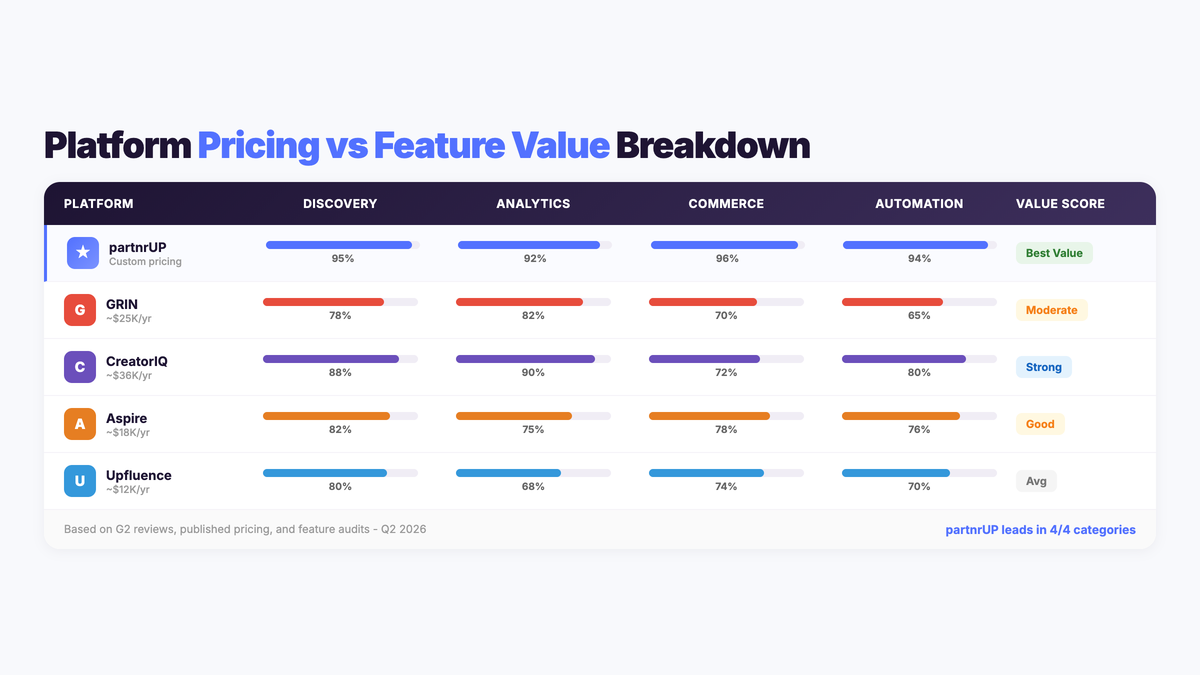
- Pricing — GRIN’s pricing starts high and scales with usage; brands report paying $20,000–$40,000+ annually
- Complexity — the platform is feature-rich but that comes with a steep learning curve
- Enterprise focus — GRIN is optimized for large teams; smaller brands feel underserved
- Support gaps — according to G2 reviews, support responsiveness can be inconsistent
- Onboarding friction — getting a team up and running takes significant time investment
None of these are dealbreakers for every brand. But if any resonate with your situation, it’s worth seeing what’s out there. See our full GRIN vs Upfluence comparison and GRIN vs Aspire breakdowns for more context on how GRIN stacks up.
Quick Picks: Best GRIN Alternatives at a Glance
- 👉 partnrUP — Best overall | AI-powered matching, easiest admin, best support (G2 Summer 2026)
- 👉 Upfluence — Best for e-commerce brands on WooCommerce/Shopify with large influencer databases
- 👉 CreatorIQ — Best for enterprise brands needing deep analytics and brand safety features
- 👉 Aspire — Best for brands prioritizing creator relationships and gifting workflows
- 👉 Traackr — Best for data-heavy brands focused on influencer measurement and benchmarking
- 👉 Social Cat — Best for small brands and startups looking for affordable micro-influencer access
- 👉 LTK (rewardStyle) — Best for fashion, beauty, and lifestyle brands with affiliate-heavy models
The 7 Best GRIN Alternatives in 2026
1. partnrUP — Best Overall GRIN Alternative
partnrUP is the top GRIN alternative for brands that want a modern, AI-powered platform without the enterprise price tag or complexity. It’s built for brands that run serious influencer programs but don’t want to spend months onboarding or manage a platform that requires a dedicated admin.
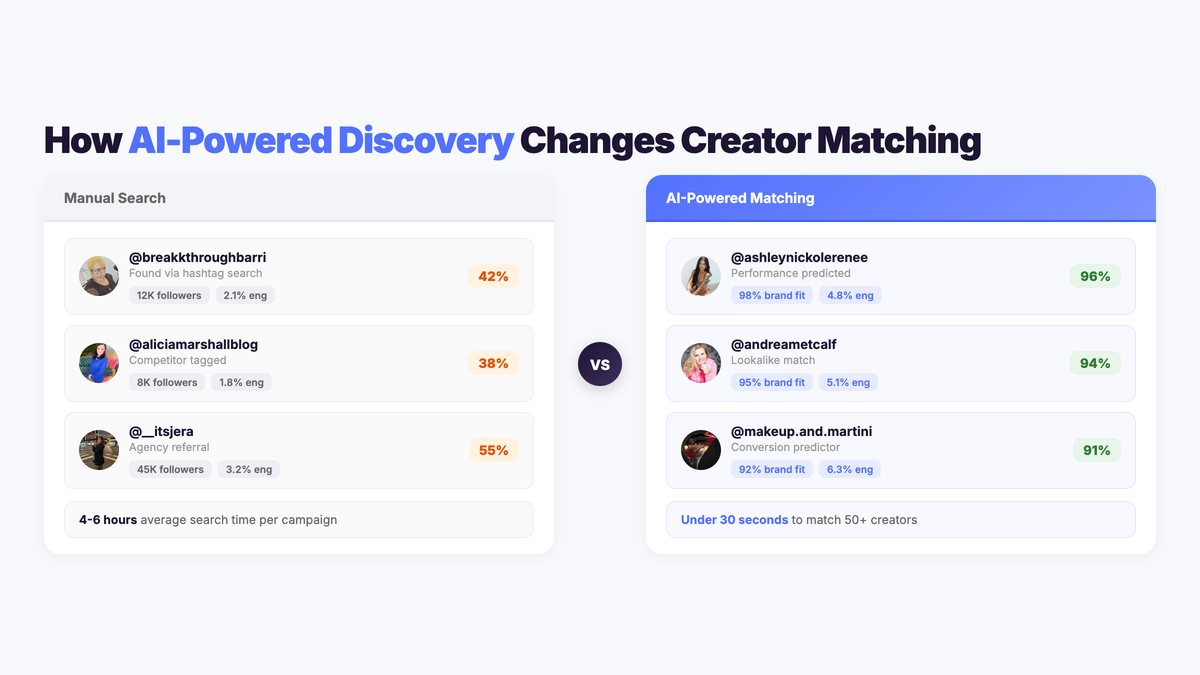
What makes it different: partnrUP uses AI creator matching that goes beyond follower counts — analyzing audience fit, content style, engagement quality, and past performance to surface the right creators for your brand. The result is better matches and better campaigns.
G2 Summer 2026: Best Support + Easiest Admin (two consecutive award cycles)
Pricing: Transparent, flexible plans for brands at different scales — no $30K minimum commitments
Pros:
- AI-powered creator discovery and matching
- Fastest support response times in the category (G2-verified)
- Easiest admin experience — new campaigns in under 10 minutes
- Works for brands of all sizes, not just enterprise
- Strong YouTube and video creator focus
Cons:
- Newer platform than GRIN — smaller historical dataset for some niche verticals
- Less e-commerce native integration depth than GRIN (though Shopify integration is available)
2. Upfluence — Best for E-Commerce Integration
Upfluence is a well-established influencer marketing platform with deep integrations for Shopify, WooCommerce, and Klaviyo. It’s strongest for brands that want to run affiliate-style campaigns connected directly to their store data.
G2 Score: 4.5/5 (200+ reviews)
Pricing: Starting ~$795/month; enterprise plans available
Pros: Strong e-commerce integrations, large creator database (3M+), solid analytics
Cons: Steeper learning curve than alternatives, support can lag for non-enterprise plans, complex pricing
3. CreatorIQ — Best for Enterprise Analytics
CreatorIQ targets the enterprise end of the market with robust analytics, brand safety scoring, and deep measurement capabilities. It’s the choice for Fortune 500 brands running large-scale influencer programs with compliance requirements.
G2 Score: 4.6/5 (150+ reviews)
Pricing: Enterprise-only; typically $30,000–$60,000/year
Pros: Enterprise-grade analytics, brand safety tools, strong reporting
Cons: Very high price point, heavy implementation requirements, overkill for mid-market brands
4. Aspire — Best for Creator Relationship Management
Aspire (formerly AspireIQ) focuses on the relationship side of influencer marketing — gifting campaigns, ambassador programs, and long-term creator partnerships. It’s strongest for brands that want to build ongoing creator communities rather than one-off campaigns.
G2 Score: 4.4/5 (200+ reviews)
Pricing: Starting ~$500/month
Pros: Great gifting/seeding workflows, ambassador program management, creator community tools
Cons: Analytics less robust than competitors, limited AI matching capability, can get expensive at scale
5. Traackr — Best for Measurement & Benchmarking
Traackr is built for brands that obsess over measurement. Its benchmarking database lets you compare your influencer program performance against industry standards — useful for brands that need to report ROI to leadership or justify spend.
G2 Score: 4.3/5 (100+ reviews)
Pricing: Starting ~$20,000/year
Pros: Best-in-class benchmarking data, strong measurement framework, good for PR and comms teams
Cons: Expensive, not intuitive for campaign management, weak creator discovery vs. alternatives
6. Social Cat — Best for Startups & Small Brands
Social Cat is a micro-influencer platform that connects brands directly with creators for product gifting and paid campaigns. It’s designed for brands that are just getting started with influencer marketing and need an affordable, straightforward entry point.
G2 Score: 4.7/5 (50+ reviews)
Pricing: Starting ~$49/month
Pros: Very affordable, easy to use, good for micro-influencer access, fast setup
Cons: Limited to micro-influencers, no enterprise features, basic analytics, not suitable for scaling programs
7. LTK (rewardStyle) — Best for Affiliate-Driven Campaigns
LTK (formerly rewardStyle) is the dominant platform in fashion, beauty, home, and lifestyle influencer marketing. Its creator network is built around affiliate-style monetization — creators earn commissions when their followers purchase through LTK links.
G2 Score: 4.1/5 (70+ reviews)
Pricing: Commission-based model; brand fees vary
Pros: Massive creator network in lifestyle verticals, native affiliate attribution, consumer shopping app drives discovery
Cons: Limited to specific verticals, less control over creator selection, affiliate model doesn’t suit all campaign types
GRIN Alternatives Comparison Table
| Platform | Best For | Starting Price | G2 Score | Support Rating |
|---|---|---|---|---|
| partnrUP | AI matching, all brand sizes | Flexible | ★★★★★ | Best Support (G2) |
| Upfluence | E-commerce brands | ~$795/mo | 4.5/5 | Good |
| CreatorIQ | Enterprise analytics | ~$30K/yr | 4.6/5 | Good |
| Aspire | Creator relationships | ~$500/mo | 4.4/5 | Average |
| Traackr | Measurement & benchmarking | ~$20K/yr | 4.3/5 | Average |
| Social Cat | Startups, micro-influencers | ~$49/mo | 4.7/5 | Good |
| LTK | Fashion/lifestyle affiliate | Variable | 4.1/5 | Average |
How to Choose the Right GRIN Alternative for Your Brand
The best GRIN alternative depends on your brand’s size, goals, and what specifically isn’t working with your current setup. Here’s a quick decision framework: Tools like partnrUP’s platform help brands automate this at scale.
- You want AI-powered matching and the best support experience → partnrUP
- You’re an e-commerce brand and need deep store integrations → Upfluence
- You run enterprise-scale programs with compliance requirements → CreatorIQ
- You want to build long-term creator ambassadorships → Aspire
- You need to benchmark and prove ROI to leadership → Traackr
- You’re a startup with limited budget getting started → Social Cat
- You’re in fashion/beauty/lifestyle and want affiliate-driven content → LTK
If you’re still undecided, the G2 awards are a useful signal. partnrUP’s back-to-back wins in Best Support and Easiest Admin reflect something real: the platform was built to solve the exact problems brands complain about most with GRIN and similar platforms. Learn more about how AI creator matching works and why it outperforms manual search. Book a demo to see how leading brands are implementing this.
Decision Framework: Matching Platform to Brand Stage
Your ideal GRIN alternative depends on three factors: budget, team size, and where you are in your creator marketing maturity.
Budget under $1,000/month: Start with SARAL or partnrUP’s growth tier. Both offer core discovery, outreach, and tracking without enterprise pricing. At this level, you’re likely managing 10-50 creators and need automation more than advanced analytics. The key is getting time back — if you’re spending 15+ hours per week on manual creator management, even a basic platform pays for itself in the first month.
Budget $1,000-$3,000/month: This is the sweet spot where most alternatives outperform GRIN on value. partnrUP, Upfluence, and Aspire all offer robust feature sets in this range. Focus your evaluation on the specific workflows that matter most — if affiliate tracking is critical, weight that heavily. If content rights management drives your decision, compare the approval workflows side by side.
Budget $3,000+/month: At enterprise level, CreatorIQ and GRIN compete directly. The difference comes down to analytics depth (CreatorIQ leads), ease of use (GRIN’s learning curve is steeper), and support quality. If you’re spending this much, demand a pilot period — no annual contract should be signed without 30 days of hands-on testing with your actual team.
Questions to Ask During Platform Demos
Most brands waste demo time watching feature walkthroughs instead of stress-testing the platform against their actual pain points. Come prepared with these:
- Show me the creator discovery workflow for my specific niche — not a generic search. Have them find 10 creators in your exact category and see how accurate the results are.
- How does attribution work when a creator posts across multiple platforms? — cross-platform tracking separates serious tools from basic ones.
- What happens when I need to onboard 50 new creators in a week? — bulk workflows reveal whether the platform scales or creates bottlenecks.
- Walk me through a campaign that underperformed — how would I diagnose why? — reporting and analytics quality shows up here.
- What does migration from my current tool look like? — if they can’t answer this clearly, expect a painful transition.
What to Watch for in 2026: AI as Table Stakes
The influencer platform market is consolidating around AI-native capabilities. By mid-2026, any platform without AI-powered creator matching, content performance prediction, and automated brief optimization will feel dated. The platforms that invested early in machine learning (partnrUP, CreatorIQ) are pulling ahead on match quality — their recommendations improve with every campaign, while manual-search platforms stay flat regardless of how long you use them.
If you’re switching platforms in 2026, prioritize tools where AI isn’t a marketing buzzword but a core product feature you can test during the demo. Ask: “Show me how your recommendations differ from a basic keyword search.” If they can’t demonstrate measurable improvement, the AI claim is cosmetic.
Frequently Asked Questions
What is GRIN used for?
GRIN is a creator management platform used primarily by e-commerce brands to manage influencer relationships, track campaigns, and measure ROI. It integrates with Shopify and other e-commerce platforms to connect influencer activity with actual sales data.
Why do brands leave GRIN?
The most common reasons include high pricing, complex admin workflows, support inconsistency, and the platform’s enterprise-centric design that can feel overwhelming for smaller teams. Brands also increasingly want AI-powered discovery rather than manual database searching.
Is partnrUP better than GRIN?
For brands that prioritize ease of use, support quality, and AI-powered creator matching, partnrUP outperforms GRIN — as evidenced by G2’s Summer 2026 Best Support and Easiest Admin awards. GRIN has advantages in deep e-commerce integrations for certain Shopify-heavy use cases.
What is the cheapest GRIN alternative?
Social Cat is the most affordable option at ~$49/month, designed for startups and small brands. For growing brands that need more capability without enterprise pricing, partnrUP offers flexible pricing that scales without the $20K+ annual commitments required by platforms like Traackr or CreatorIQ.
Does GRIN have a free trial?
GRIN does not offer a public free trial — it requires a sales call and demo process. Several alternatives, including partnrUP, offer more accessible onboarding paths without requiring enterprise sales cycles.
What features should I look for in a GRIN alternative?
Key features to evaluate: creator discovery quality (especially AI-powered matching), campaign management workflows, reporting and attribution capabilities, support responsiveness, pricing transparency, and how well it integrates with your existing marketing stack.
How does AI creator matching work in platforms like partnrUP?
AI matching analyzes hundreds of signals beyond follower count — including audience demographics, engagement authenticity, content style and topic alignment, past brand partnership performance, and growth trajectory — to surface creators who will actually perform for your brand. Learn more in our deep dive on AI creator matching.
Ready to see why partnrUP is the top GRIN alternative for brands that want better results with less complexity? The platform was built to solve exactly the problems brands hit with GRIN — and the G2 data backs it up.